Saturday, May 4, 2013

Racism and the shocking GUPTA family

                                                         Picture - abi-shameena.blogspot.com

Whilst apartheid has been abolished many years ago, racism in South Africa is still rearing its ugly head. A few days ago I was having a conversation with an elderly white Afrikaans speaking woman. I asked her about her origins and where she grew up. Quite casually she replied stating that she was born in the Nelspruit region of South Africa on a farm that was surrounded by many plantations. There was apparently only one supermarket along with three " coolie" shops. I was quite surprised that she actually chose to use the derogatory word "coolie". As she was an old woman I did not lash out at her and her overall demeanour and mannerism with me was quite a pleasant one. Whilst in the company of friends recently, a gentleman in our company related a story to me that totally disgusted me. At a birthday party, the birthday girl was gifted with a substantial amount of money. One of the family members took the money and hid it away in a safe place. However, when it was time to leave the venue, they could not remember where they placed the money. Hence they started accusing the waiters on duty of stealing the money. After a few minutes of moaning and groaning eventually the money was found. The manager of the venue then asked the family to kindly apologize to all the staff members. In quite a rude manner, the mother of the family said that she will not apologize to black people. In other words it is below her to apologize to a black person. What kind of a sick mentality is that? And then we have the GUPTA FAMILY who think as though they own South Africa. Businessman Mr. Atul Gupta says that South Africans should be thankful for the investment the Gupta family is bringing to the country.He did not understand why there was a concern about the landing of an aircraft chartered by the family at Waterkloof Air Force. Well I guess with excessive amounts of wealth, it is easy to bribe anyone to get anything that is desired. After all bribery and corruption is the order of the day in South Africa. There are new reports surfacing stating that the Gupta family insisted on being served by either White or Indian chefs and waiters only. They refused to have black waiters serving them. These reports have apparently quoted a member of the management team at the Lost City Hotel. If these reports are true and I'm sure, very soon the truth will prevail, I do not think that we as South Africans need to welcome such despicable people into our country. It is a shame that they hail from the very same country as the great Mahatma Gandhi, who came to South Africa to fight for the rights of Asians in this country and to liberate Asians from the clutches of apartheid and to bring about equality between all people irrespective of race, colour or creed.

Wednesday, May 1, 2013

South African religious scholars going Cuckoo

Photo: I was invited for lunch this afternoon at a friends home as they are leaving for Umrah tomorrow afternoon. May Allah take them safely and accept their umrah Insha allah. Ameen. Whilst sitting and chatting to members of the extended family about the mundane activities of life, suddenly one lady brought up the topic of the Turkish mosque and praised the masjid for its extreme beauty and architecture. She also made mention that she would love to be at the masjid during the month of Ramadhaan. Then a few other women joined in the discussion and I was shocked beyond belief that a few of the women mentioned that recently they attended an Islamic program whereby they were told by a 'Deobandi" scholar that they should not visit  the Turkish masjid. For heaven sake, the masjid is a place of worship, why shouldn't South African Muslims visit the masjid. Is it because South African Indian Muslims are far more superior over Turkish Muslims. What kind of mentality is this? This is not what the Prophet Muhammed (saw) taught us. I think some of our South African religious scholars are going cookoos....They are losing it. Instead of uniting people they are dividing the community day by day.My late grandfather would perform his salaah in any masjid, whether it was built by the Sunni community or the Sufi community or any other community. He would always say that it is only a masjid, a building, a place of worship. What you have in your heart is between you and your creator.Performing salaah in a masjid built by a differing sect only encourages dialogue and creates respect between people. The minute you start saying you can not perform salaah in that masjid because it is built by those people, that's when division is created within communities.A big thumbs up and hats off to Mr. Ali for giving South Africa a piece of Turkey. Through him, nations have now formed a bond and a connection and he has accomplished something that many wealthy Muslim South Africans could not achieve.To these foolish religious scholars who are famous for judging, branding and labeling people, I honestly feel sorry for all of you, for you have missed your goal in life and that is to unite the Muslim Ummah. It is narrated in Saheeh Muslim that the Prophet (saw) said :"My ummah will be divided into seventy three sects. All of them will be in the Fire except one."Thus at present we can see that our very own religious scholars are causing our Muslim societies to divide into various sects and schools of thought. Islam is such a simple religion that can accommodate to the needs of any person irrespective of class, creed or nationality. All we need to do is follow the sunnah and way of life of our beloved Prophet Muhammed (saw) and remain steadfast on the teachings of the Quraan. Everything else is absolute nonsense and baseless innovations in my opinion.....
I thought the Saudi religious police were crazy, but I think the South African religious scholars are not far off.

I was invited for lunch this afternoon at a friends home as they are leaving for Umrah tomorrow afternoon. May Allah take them safely and accept their umrah Insha allah. Ameen. Whilst sitting and chatting to members of the extended family about the mundane activities of life, suddenly one lady brought up the topic of the Turkish mosque and praised the masjid for its extreme beauty and architecture. She also made mention that she would love to be at the masjid during the month of Ramadhaan. Then a few other women joined in the discussion and I was shocked beyond belief that a few of the women mentioned that recently they attended an Islamic program whereby they were told by a 'Deobandi" scholar that they should not visit the Turkish masjid. For heaven sake, the masjid is a place of worship, why shouldn't South African Muslims visit the masjid. Is it because South African Indian Muslims are far more superior over Turkish Muslims. What kind of mentality is this? This is not what the Prophet Muhammed (saw) taught us. I think some of our South African religious scholars are going cuckoos....They are losing it. Instead of uniting people they are dividing the community day by day.My late grandfather would perform his salaah in any masjid, whether it was built by the Sunni community or the Sufi community or any other community. He would always say that it is only a masjid, a building, a place of worship. What you have in your heart is between you and your creator.Performing salaah in a masjid built by a differing sect only encourages dialogue and creates respect between people. The minute you start saying you can not perform salaah in that masjid because it is built by those people, that's when division is created within communities.A big thumbs up and hats off to Mr. Ali for giving South Africa a piece of Turkey. Through him, nations have now formed a bond and a connection and he has accomplished something that many wealthy Muslim South Africans could not achieve.To these foolish religious scholars who are famous for judging, branding and labeling people, I honestly feel sorry for all of you, for you have missed your goal in life and that is to unite the Muslim Ummah. It is narrated in Saheeh Muslim that the Prophet (saw) said :"My ummah will be divided into seventy three sects. All of them will be in the Fire except one."Thus at present we can see that our very own religious scholars are causing our Muslim societies to divide into various sects and schools of thought. Islam is such a simple religion that can accommodate to the needs of any person irrespective of class, creed or nationality. All we need to do is follow the sunnah and way of life of our beloved Prophet Muhammed (saw) and remain steadfast on the teachings of the Quraan. Everything else is absolute nonsense and baseless innovations in my opinion.....

Tuesday, April 30, 2013

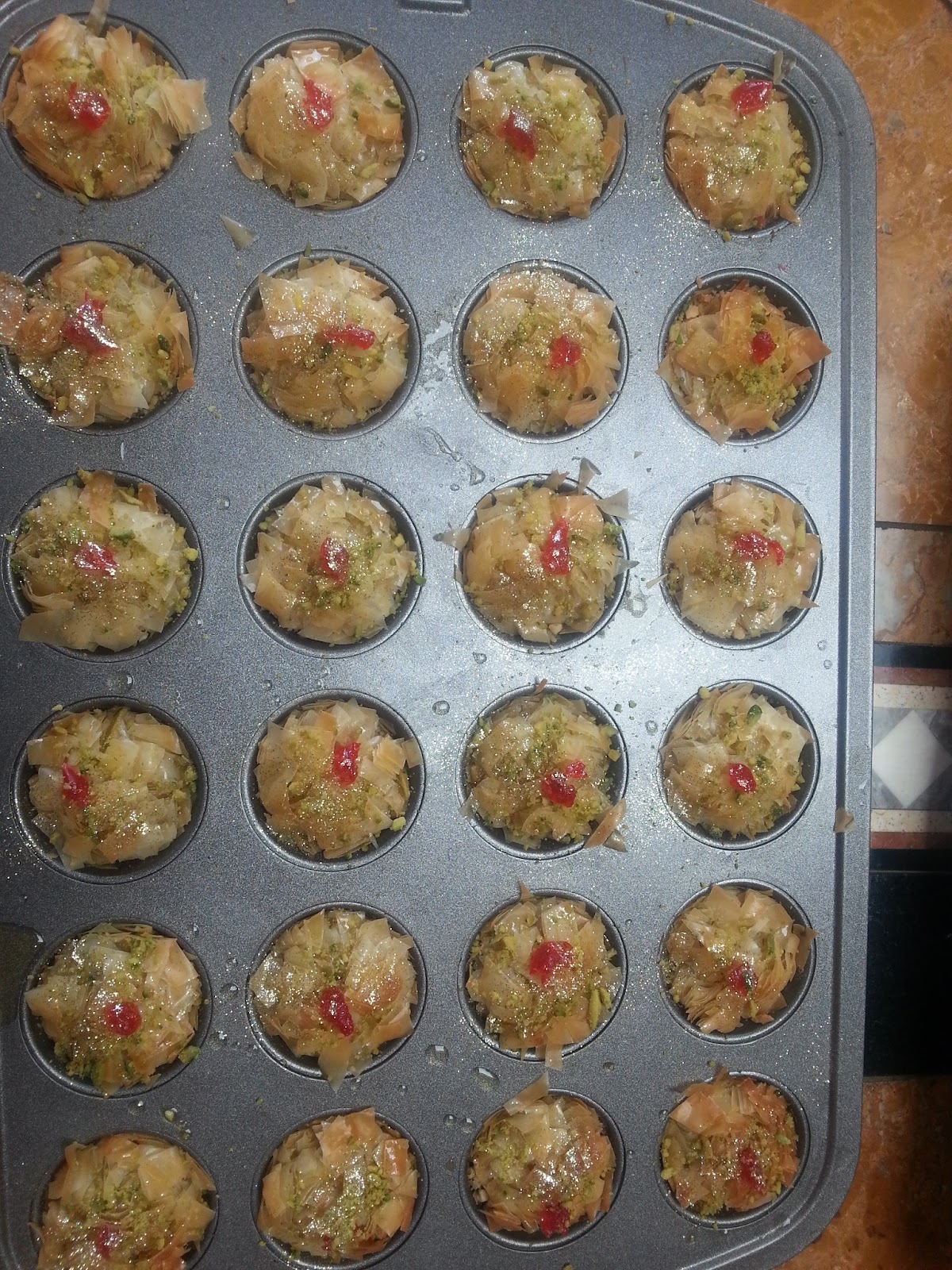
A sweet fit for a King - Baklava

Baklava is a sweet made of layers of phyllo pastry filled with a variety of nuts and sweetened with syrup or honey. It is characteristic of the cuisines of the former Ottoman Empire and those of Central and Southwest Asia. According  to wikipedia, the word baklava is first attested in English in 1650,a borrowing from Ottoman Turkish باقلوا /bɑːklɑvɑ. The history of baklava is not well documented. It has been claimed by many ethnic groups, but there is strong evidence that its current form was developed in the imperial kitchens of the Topkapı Palace based on a Central Asian Turkic tradition of layered breads. In today's post I will show you two methods of making delicious baklava. You can either make the baklava into diamond shapes or you can make them round and dainty in small cup cake pans. Either way, once baked, the baklavas look stunning and visually appealing to the eyes. They don't only look beautiful on a fancy platter but they are also mouth wateringly delicious.

                                            1. Buy phyllo pastry from your local supermarket

                                            2. Open up the dough bit my bit taking care that
                                                the dough does not dry out. With a pair of
                                                scissors cut the dough into small pieces and pack
                                                away into a packet.

                                            3. Seal the packet tightly if you not going to use the
                                                dough immediately

                                            4. Take spray and cook and line the cup cake
                                                 pans.

                                            5.Take the shredded pieces of phyllo dough and place in
                                               pan

                                              6. Add the filling on top of the shredded phyllo. 
                                                  Filling: 250g of coarsely ground almonds
                                                            (Pistachios can also be used or a 
                                                             combination of both almonds can 
                                                             and pistachios can be used)
                                                             1 dessert spoon flour
                                                             1 dessert spoon sugar
                                                   Once the filling is added top up with more 
                                                    shredded phyllo pastry

                                  7. Now add 1 dessert spoon of ghee (clarified butter) over
                                   the phyllo pastry and then press down firmly. Then bake in the
                                   oven at 180 degrees.
     
                                8. Once the baklava is baked pour over cold syrup on top of the
                                    warm baklava.
                                    Syrup: 2 cups of water
                                               2 cups of sugar.
                                               Boil the above two ingredients until the consistency is
                                               sticky. Then add:
                                               A few drops of rose essence
                                               A pinch of tartaric acid
                                               1/4 cup of golden syrup
                                                Boil the mixture for another ten minutes

                                             9. Decorate with ground pistachios and
                                                 cherries

                                10. VOILA!!!! Bon appetit!!!

Diamond Shape Baklavas
                                              1. Phyllo pastry usually comprises of a few layers.
                                                  Separate the layers into 6 sheets each. Place
                                                  6 sheets on a tray. Then place the filling over.

                                             2. Then cut strips right through the layers of phyllo
                                           
                                           3. Then cut the strips at an angle to form diamonds. Now
                                            pour over the ghee (clarified butter) making sure that it
                                            penetrates through all the  layers of phyllo pastry. Then
                                            bake in the oven at 180 degrees

                                            4. Once the baklava is baked, pour over the cold
                                                syrup over the hot baklava

                                             5. Decorate with crushed pistachios and enjoy...

Monday, April 29, 2013

Saudi man dies at 120


Photo: Oldest Saudi man dies at 120
Image Credit: Sabq

A Saudi, believed to be the oldest man in the country, has died, his family said.
Shaikh Awadh Bin Abdul Aziz Al Saifi, 120, was born in 1893 and lived in three different centuries, the 19th, 20th and 21st, local news site Sabq reported.
He is survived by 24 sons and daughters and had 447 grandchildren and great grand-children.His oldest son is 98 years old while the youngest is 22. His oldest grandson is 65 years old. This story reminds me of a patient of mine who use to frequent the hospital on a monthly basis. He is 112 years old and doesn't really have any medical history apart from pain in the joints. I use to always tell him that he is a walking, talking history book. I use to spend hours conversing with him. He related stories to me about the Ottoman empire and also the fascination he experienced at seeing a car in the city of Makkah driven by the founding king, King Abdulaziz al Saud. In fact it was the first car that Saudi Arabia ever had and not only him, but everyone in Makkah were astonished at the sight of the vehicle. He mentioned to me that the Saudi military in the past wore thobes along with shemagh and iqals ( the black double rings worn on top of the checkered scarf), the  only difference being that their iqals were broad and huge. This is what differentiated them from the general public. He also told me about King Abdulaziz's generosity. During the month of ramadhaan, he was sitting in the company of King Abdulaziz in the haram area in Makkah. Just before the sunset, the king took out money from his thobe and sent him to buy food to break the fast with. He also insisted that the food should be distributed to as many poor people as possible. The king broke his fast with zam zam water and dates and only after everyone around him ate to their hearts content did he partake of the food. I miss this patient of mine dearly as I use to look forward to his monthly visits to the hospital. His knowledge and experience in life is priceless and I feel blessed and honoured to have been a part of his life. May Allah give him an even longer life of good health and bless him with the highest stages of Jannah. Ameen.
                                                                    Image Credit: Sabq

A Saudi, believed to be the oldest man in the country, has died, his family said.
Shaikh Awadh Bin Abdul Aziz Al Saifi, 120, was born in 1893 and lived in three different centuries, the 19th, 20th and 21st, local news site Gulf news reported.
He is survived by 24 sons and daughters and had 447 grandchildren and great grand-children.His oldest son is 98 years old while the youngest is 22. His oldest grandson is 65 years old. Earlier on this year,a 
Saudi man who was dubbed “the dean of centenarians” died in the Kingdom at the age of 154 years. Nearly four years ago his name was listed in the Guinness World Record for being the oldest living man in the world, Arab news reported. Mohammed bin Zarei died of old age at a hospital in the small village of Sadr Ayad near the southern town of Nammas, leaving behind more than 180 children, grandchildren and great grandchildren.
He had 10 wives and the age of 150, he told a local TV station that he was looking for a new wife after all his wives died. “Bin Zarei (…) had seen all the kings that ruled Saudi Arabia,” one newspaper said. Bin Zarei hit headlines when the Saudi satellite TV news channel Alarabiya broadcast a film about him a few years ago, during which he said he was in a good health.The program presenter, Saud Al-Khalaf, called him “the dean of centenarians.” 


Mohammed-bin-Zarei.jpg
                                                                    Mohammed bin Zarei

This story reminds me of a patient of mine who use to frequent the hospital on a monthly basis. He is 112 years old and doesn't really have any medical history apart from pain in the joints. I use to always tell him that he is a walking, talking history book. I use to spend hours conversing with him. He related stories to me about the Ottoman empire and also the fascination he experienced at seeing a car in the city of Makkah driven by the founding king, King Abdulaziz al Saud. In fact it was the first car that Saudi Arabia ever had and not only him, but everyone in Makkah were astonished at the sight of the vehicle. He mentioned to me that the Saudi military in the past wore thobes along with shemagh and iqals ( the black double rings worn on top of the checkered scarf), the only difference being that their iqals were broad and huge. This is what differentiated them from the general public. He also told me about King Abdulaziz's generosity. During the month of ramadhaan, he was sitting in the company of King Abdulaziz in the haram area in Makkah. Just before the sunset, the king took out money from his thobe and sent him to buy food to break the fast with. He also insisted that the food should be distributed to as many poor people as possible. The king broke his fast with zam zam water and dates and only after everyone around him ate to their hearts content did he partake of the food. I miss this patient of mine dearly as I use to look forward to his monthly visits to the hospital. His knowledge and experience in life is priceless and I feel blessed and honoured to have been a part of his life. May Allah give him an even longer life of good health and bless him with the highest stages of Jannah. Ameen.